Sunday, August 19, 2012

2000 Beers on the Streets of Berlin

It was a cold and rainy Friday morning in Berlin. Reminiscent of an average day in Portland, Oregon, temperatures were in the low 50s, the skies were dark and gray, and a gentle sprinkle was falling from the sky. By noon it hadn't really cleared up, but it was of no matter: I grabbed my umbrella and coat and headed for the U-Bahn. It was time for the Berlin Beer Festival.

The Sixteenth Internationales Berliner Bierfestival was held during the first weekend of August. They boast being the largest beer garden in the world, and with over 2000 beers stretching 2.6 km through the heart of downtown Berlin, I would wager this isn't a ludicrous claim.

Unlike an American beer festival, the BBF is a pay-as-you-go event. Free to enter, participants are encouraged to buy the Festival Bierstein which reduces the price of each beer €1 – €1,50 (depending upon the brewery). Considering I ended up attending thirteen hours of the festival and drank ... well, a lot of different beers, it turned out to be a pretty solid purchase. It wasn't long before it was filled with a Störtebecker Schwarzbier, and I was sipping some great German beer.

Like many beer enthusiasts, one of my primary goals of attending a beer festival is to taste as many different beers as possible. It's a matter of pacing and moderation: one can't drink too much or too fast, or one quickly looses not only their sobriety, but also all ability to discern any real differences between the various beers. This is aided by the fact that an American beer festival is only allowed – by law – to pour the attendee one or two ounces (approx 0.06 litres) of beer at a time. This moderation proved to be an immense challenge at BBF: a pour wasn't two ounces, but rather two hundred millitres (6.75 oz). And with 2000 beers at the festival? It was simple math: I was going to have to be very selective.

I was able to eliminate about 33% of the beers right off the bat as dozens upon dozens of macrobreweries were present. Thus I avoided Hoegaarden, Heineken, Red Stripe, Tsingtao, Stiegel, Palm, Rosen, Spaten, Paulaner, Krombacher, Berliner Kindl... the list goes on and on.

Instead, I focussed on those breweries that I may never have the opportunity to try again, for example Radniční Pivovar Jihlava, Zwiesel Dampfbier, Merkendorfer Hummel-Bräu, and Hofbräuhaus Traunstein. Finding these breweries, however: this proved to be an immense challenge. Though a map – which divided the festival into regions – was published online, this in no way corresponded to the actual physical placement of the brewery. To add to the confusion, upon buying my Festival Stein, I was given a second – and contradictory – "map" which displayed numbers ranging from 53 to 143 (I'm still not clear what exactly these numbers represented) and provided a massive list of breweries, all the while neglecting to show their whereabouts. In this regard, the BBF could certainly stand for improvement!
Weiherer Kellerbier: Wonderful lemon/hop aroma, clean
and clear, excellend flavors of caramel and hay.

Schönram Pils: Crisp & dry, nutty with
tropical fruits, and a hint of minerals.
As for the beer itself: the absolute standout was Camba Bavaria's Pale Ale, a beer I will be discussing further in a future post. I tasted two wonderful Pilseners, one from Schönram (pictured right), the other from Störtebecker. Also fantastic were the Weiherer Kellerbier and the Kreuzenberger Klosterbier.

But as good as these beers were, one of the most surprising aspects of the festival were the beers missing: despite being held in Berlin, Berlin's only craft brewer – Brewbaker – was absent. So was Braufaktum, arguably the most important craft brewer in Germany. The festival was definitely geared towards larger breweries with a massive output, leaving out smaller brewers like Brau Kunst Keller, Freigeist Bierkultur, and Fritz.


And therein was the primary difference between the Berlin Beer Festival and just about any American beer festival. The American Beer Festival tends to be a tasting event for beer enthusiasts: usually held inside a convention center, it has a $50 admittance, lasts three hours, limits the pour size, serves sub-par food, and has a strict policy against drunkenness. And among its most important aspects is the opportunity for a small micro- or nanobrewery to advertise their product in an environment of potential customers.

By contrast, the Berlin Beer Festival is a family oriented event that celebrates a good time and uses beer as an excuse to come together and party or relax. This was an event for all ages: you don't want a beer? No problem! Have a soda, or a juice, or an ice cream. Hungry? Have a bratwurst, a cookie, or candy. Honestly, it reminded me much more of a county fair, complete with sixteen music-stages featuring local musical talent. People came and went as they chose, and everyone seemed to be having a pretty good time. The small microbrewer? There probably isn't any way they could have brewed enough beer to serve the sheer quantity of thirsty participants.

At the end of the festival, I was left pondering just how different these two festival styles are. In many ways, I envy the German mentality towards beer. I wish the cities of the United States were allowed to put on events like this: this was a social event and I had a blast from start to finish. I met amazing people, had great conversation, and can think of few better ways to spend a weekend (especially once the sun started to shine).

But I really don't think I would ever be willing to sacrifice the American beer festival experience. Though I tasted some wonderful beer at BBF, in contrast, at the last American festival I attended, I tasted some beer that simply blew my mind away. While there, I met brilliant brewers who were true artists, but I doubt that a single brewer bothered to show up at BBF.

Would I trade one for the other? Never. Is one experience better than the other? Not at all. If anything, this festival made me appreciate the immense diversity of cultures surrounding the enjoyment of beer, and it reminded me how lucky I am to have experienced so many of them.

Prost!

-keith

CORRECTION: It appears not all American beer festivals are the same, and though those I have attended limit the hours and the consumption, it would seem that all do not. The Oregon Brewers Festival was brought to my attention as a primary counter example, and upon reviewing the website, it is clear that it shares several similar characteristics to the Berlin Beer Festival: free admission, hours from noon to midnight, and pours ranging from three to fourteen ounces.

I also want to clarify my comment that "an American beer festival is only allowed – by law – to pour the attendee one to two ounces of beer." There is no national law dictating such measures, but it is rather determined by the individual states. Hence, in Massachusetts, state law limits the pour size for all public tastings to 2 oz. Oregon, in contrast, has no such law.

I apologize for the misinformation, and I thank my readers for the correction.

Saturday, August 4, 2012

The Beers of Darmstadt


Unless you're a WWII historian, a composer, or one of the 145,000 residents, chances are you haven't heard of this small German college-town. Roughly 30 km outside Frankfurt in Hessen, Darmstadt lacks many of the quaint characteristics of nearby Heidelburg due to the fact that it was destroyed during a British bombing raid in 1944. Like many German towns that shared a similar fate, when Darmstadt rebuilt after the war it opted for a relatively plain architecture that was efficient and practical.

Despite this, Darmstadt happens to be the home of one of the world's most important New Music festivals in the world. Founded in 1946 by Wolfgang Steincecke, the Internationale Ferienkurse für Neue Musik, Darmstadt has been the summer home for many of the world's most important composers including Stockhausen, Boulez, Henze, Varèse, Xenakis, Ligeti, and others. These courses are so significant, that the "Darmstadt School" actually refers to a particular style of musical composition that is explored in every modern textbook on music history. Ironically, the young composers of the world probably know more about Darmstadt then most of the residents living there.

Like several other hundred composers, I too descended upon Darmstadt in mid-July to hear some amazing new compositions. This wasn't my first time in Darmstadt: my wife, due to uncanny coincidence, has been singing for the Darmstadt opera for the past couple years. As such, I've gotten to know both the city and its beers pretty well.

Darmstadt can boast three breweries: Darmstädter Privatbrauerei, Darmstädter Ratskeller Hausbrauerei, and Grohe Brauerei. Darmstädter Privatbrauereri (or just Darmstädter) is the town's requisite macro-brewery. It is everywhere in the city, and quite literally more easily available (and less expensive) than water. Darmstädter is served at nearly every bar and during intermission of every concert.
Photo by Sven Rumbler & Google Earth

Darmstädter brews fourteen different beers which include two different alcohol free beers, two Radlers (a "mixed drink" that is half lemonade and half Pilsener), a couple of seasonals, and then a smattering of different Pilseners and Wheat Beers. The most common of their beers are the two Pilseners (Braustüb'l Pilsner and Darmstädter), though their Weissbier is pretty commonly seen as well.

Generally speaking, Darmstädter beers are pretty dull, uninteresting, and lack any true character or identity. They are easy drinking and unoffensive which is exactly what the average German beer-consumer enjoys. It's beer for the masses.


Darmstädter Ratskeller Hausbrauerei (or just Ratskeller) is a lovely brewery in the Marktplatz right in the center of town. If Darmstadt were a tourist town, I'd say this was the town's tourist brewery. It's cute with exposed brew kettles, serves quality German food, and is always crowded. It's definitely best to visit in the summer when there is outdoor seating: inside can get a bit cramped and there is often no space at the tables.

Ratskeller has three year-round beers: a Hefeweizen, a Pilsener (pictured at right), and the "Spezial" Dunkler. And though I have never had it, I am told they also brew a Doppelbock that is available for about four weeks up to December 23rd.

The Dunkler is the least interesting of the three beers being generally refreshing with a slight hint of caramel. The Hefe is a lovely beer with a lot of lemon citrus and banana flavors and a nose that borders on a Belgian Wit. The Pilsener ranks, in my opinion, as the best Pilsener in town. Pouring beautifully with tremendous foamy head, it's crisp and clean with a good but mild noble hop presence, and a bit of a mineral bite. And on a hot summer day sitting on the outside terrace, it's tough to beat. Ratskeller's beer is only available at the brewery, and they do not bottle.

The Grohe Brauerei (not to be confused with the Grohe toilet company!) is easily the best overall brewery in town. It's a little off the main-path with a beer garden that is enclosed by a wall. In fact, if one doesn't know what to look for, it's pretty easy to pass. The food is excellent: traditional German fare, the wurst is among the best I've had and the flammkuchen is spectacular.

Like the Ratskeller, Grohe also serves three beers (a Hefe, a Pils, and a seasonal beer) and a lemon-lime soda. The seasonal is a Märzen and an excellent one at that: darker in color but crisp and clean, there is a slightly sour tinge to it that is wonderfully thirst-quenching. The Hefe is very similar to that at the Ratskeller, however it has a little more clove spiciness that gives it just that little extra bit of depth. However, as good as the other two beers are, the Pils is a huge disappointment: pouring with no head, it's unusually sweet and syrupy, nothing like what a Pils could and should be. It was so off, it left me wondering if there was something wrong with the tap lines. Grohe does bottle their beer, and these beers can be found in various liquor stores and gas stations in town. Their beer is also available at select restaurants in the area.

If you are going to be traveling to Germany, Darmstadt is not a town I would generally recommend going out of your way to visit. Though both Grohe and Ratskeller serve fantastic beers, while they are the best beer in the area, they certainly aren't among the best in the country. However, if you are nearby and travelling through – perhaps from Frankfurt to Heidelberg – I would encourage a short stop-over to taste some pretty good examples of German cuisine and beer styles. And if you stop by Grohe, tell Viktor that I say hello!

Prost!

-keith


Monday, July 16, 2012

Wo bist du, Berliner Weisse?

When I first told my beer-loving friends I was going to spend the summer in Berlin, if I didn't get a smirk and a lecture about how bad of a beer city Berlin is, I was generally greeted with this response:

          "Enjoy lots of Berliner Weisse!"

Berliner Weisse is the traditional beer of Berlin, having been brewed for hundreds of years. It is a low alcohol beer that is crisp and light, tart, and a bit sour. Napoleon described the beer as "effervescent" and "the Champagne of the north." A wheat beer that is traditionally not boiled and served very fresh, the sourness comes from lactic acid bacteria (Lactobacillus delbrückii) and occasionally traces of Brettanomyces. Perhaps the best description comes from Henry Vizetelly from his 1879 book Berlin Under the New Empire:


"In front of everyone stood a gigantic tumbler which could have been fitted with ease upon any ordinary head, and which contained a liquid pale and clear as Rhine wine, surmounted by a huge crown of froth not unlike a prize cauliflower. This was he famous 'weiss,' the mere mention of which suffices to send a Berliner into raptures and into the mysteries of which I was about to be initiated... [The beer] should be largely impregnated with carbonic acid gas and have acquired a peculiar sharp, dry, and by no means disagreeable flavor."
Like many other sour beers, Berliner Weisse is becoming increasingly popular in the United State. Most fans of the style have likely tried Dr. Fritz Briem's version, brewed at Weihenstephan in Germany and based off a traditional recipe from 1809. (This was, in fact, the beer that introduced me to the style.) But there are also dozens of American breweries trying their hands at the style, ranging from traditional versions like that found at Southampton Publick House to more experimental versions like the Somer Weisse from Night Shift. In fact, a glance at the list of the top Berliner Weisses at Beer Advocate reveals only 10% of the beers are made in Germany, while 82% come from the United States. Like many traditional German styles, the Germans just baren't brewing them anymore.

As of June 1st there was only one brewery in the city brewing a Berliner Weisse, this being the macrobrew Berliner Kindl Weisse. It is not a terribly difficult beer to find, though if you were to see it on the street, you'd likely have no idea you were looking at a beer.

In modern-day Berlin, the Berliner Weisse is served "rot oder grün." In other words, with red (raspberry) or green (woodruff) syrup. And it's served with a straw. In a bowl (or occasionally the goblet pictured right).

Since 2006, Berliner Kindl Weisse has been flash pasturized and is no longer bottle conditioned. The beer pours a pale, slightly cloudy gold and has a tart, lemony sourness to it. Very little finish, the beer is certainly refreshing, though honestly I wasn't terribly excited by it either.

But apparently I picked the right time to come to Berlin, because last week I had the opportunity to try two new additional Berliner Weisse's that are unique to Berlin. The first was from Brewbaker, the Berlin micro-brewery I wrote in great length about in my last post. Released on July 1st, the beer – which I tasted at the brewery – had a refreshing, almost musty character with lots of carbonation but a quickly fading head. Lots of lemon flavor, it was sour but not mouth-puckering and tremendously refreshing.

I was fairly certain that these would be the only two Weisses I would have the fortune to taste while in Berlin. But again, I was surprised when I walked into Das Meisterstück: Berlin's only Craft Beer Bar (more on this in an upcoming post). In their cooler was an unmarked bottle which was described to me as a Weisse brewed by a Mr. Marshall (an American) at Brauwesen – the local brewing school at the Berlin Technical Institute. And this beer might just be the best Weisse I've ever had.

Though tremendously sour (easily the most sour of the three), it was tremendously drinkable, light in body but in no way watery. There was a lemon character that was balanced with a light hops, as well as a hint of salt and a slight smokiness that lent it a depth the other beers just didn't have. This wasn't a far-fetched idea either: until 1860, the brewers of Berliner Weisse brewed the beer with smoked wheat malt. But unlike the Smoked Berliner Weisse from Freigeist Bier Kultur, the smokiness was very much in the background, and really just served to give the beer a little deeper dimension.

I am in Darmstadt for the next couple weeks, but when I return to berlin in August, I hope to learn more about Brauwesen and Mr. Marshall: though just a student, he might already be among Berlin's best brewers.

"Wo bist du, Berliner Weisse? Where have you gone?"

"Ich bin hier, Keith! In Berlin! Right where I should be!"

Prost!

-keith


Tuesday, July 10, 2012

The Beers of Berlin (Weekly Roundup 1)

It has been a week since I first arrived in Berlin, and I am thoroughly taken with the city. I have taken in two concerts (including a wonderful performance of Wolfgang Rihm's new opera, Dionysus), visited the Surrealist museum, edited and mastered two recordings for an upcoming album release, and, of course, drank a lot of beer.

Since my last post, I have visited three of Berlin's many breweries. First, I visited Brauhaus Lemke, a pleasant little brewpub outside of the Charlottenburg Palace (there is also a location right outside Alexanderplatz). With lovely outdoor patio seating, the menu featured typical German fare and four housemade beers: Lemke "Original," a Pilsener, a Hefe, and a Maibock – the last two of which I sampled.
Lemke Weizen

The Maibock was the less remarkable of the two. A very subtle nose with faintly sweet aromas of raspberry and honey, it had an under-spoken mouth that was lightly fruity with a full caramel malt flavor and faint hops.

The Weizen was tremendously light in the mouth, springy with flavors of lemon meringue, banana candy, bubblegum, and a deep bready finish. It wasn't terribly spicy with the cloves taking a definite backseat, and though it wasn't a standout Hefe, it was very enjoyable and accompanied my meal perfectly.

The second brewery I visited was the Microbrauerei Marcus Bräu. I tasted two of their three offerings: a Pilsener and a Hefe. The Pilsener was a "C+" at best, pouring a very cloudy gold with no distinctive character or flavor. The Hefe was unquestionably among the worst Weizens I've ever tasted, bringing in flavors of dirty laundry and bleach. If this were the standard for the Berlin Brewery, the city would be in great trouble!

But wait! There is an interesting brewery in Berlin who brews beer well outside the national norm. Their name is Brewbaker, and they are but a mere 4km (or three train stops) from my apartment. Charming atmosphere, excellent fresh food, and a most pleasant wait-staff, my wife and I enjoyed an IPA and an Oatmeal Stout.

Yes, that's an IPA and Oatmeal Stout being brewed in Berlin, by Berliners, for Berliners. I don't really know much about their history or their customer base, but it is encouraging to find some creative brewers within the city limits.

Both beers were served out of 22oz bottles in wine glasses. The IPA was an English-style IPA and is only the second German IPA I've had (the other being an American-style from BrauFactum in Frankfurt). The beer had a mildly citrus nose, was lightly hoppy with very little carbonation. The Stout – easily the better of the two – had a strong coffee aroma with a nice roasted chocolate malt flavor and a slight hint of bitter chocolate. Both beers were well made, and though not extraordinary when compared to their brethren from other countries, easily ranked as the best beers of Berlin.

So far.

Later this week I hope to visit some of the city's other breweries, as well as a little Craft Beer Bar I may have discovered. Stay tuned...

Prost!

-keith


Thursday, July 5, 2012

The Perfect Pils, Part 2

I arrived in Germany on the 2nd of July. Berlin has been remarkably temperate, featuring temperatures around 72° - 76° F (22° - 25° C). My apartment is in a wonderful part of town which straddles the Charlottenburg and West Berlin line, and there is a very fine coffee roaster right next door (which I visited for the first time yesterday and was surprised to see a 25 page menu featuring all their different roasts and brewing methods). But as this isn't a coffee blog, allow me to continue onto the beer.

I had been warned by several people in-the-know that Berlin isn't a great beer town. Not to be deterred, I assembled a map of every brewery and bottle store, and, naturally, hit up one of these bottle stores on my first day.

I picked up several interesting looking beers, including one curious looking Pilsener which I tasted yesterday afternoon.

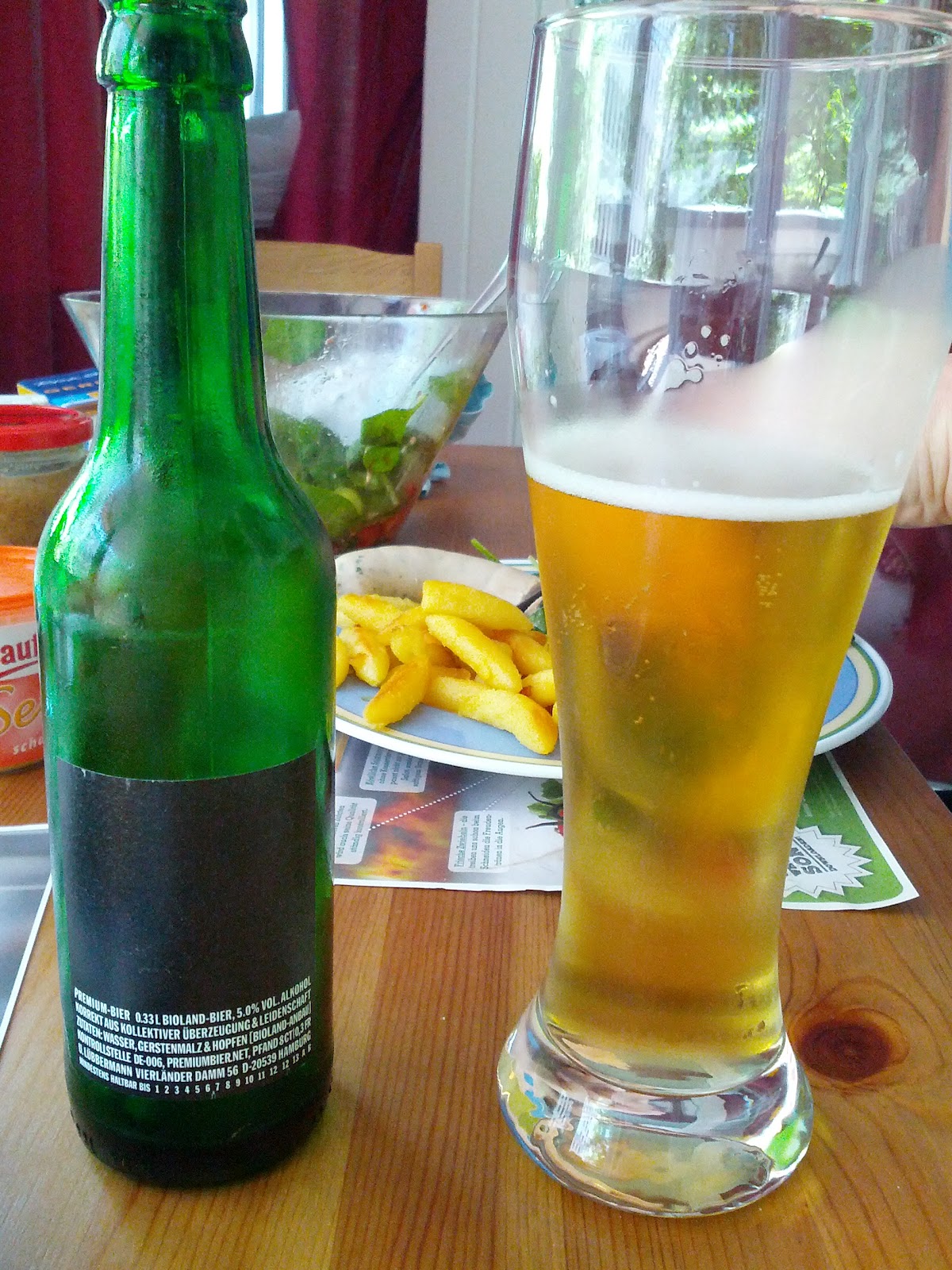
I am a sucker for good labeling, and this label was among the most unique I've seen: a solid black label with small white lettering, I had to read it several times before I could figure out who the brewer was. The answer? "Premium-Bier." Talk direct and to the point!

There is no entry for them on either Beer Advocate or Rate Beer, and their website doesn't reveal as much as I would have hoped (and my German is not terribly great to begin with). But from what I can gather, they are a tiny 100% organic soda and beer brewery based in Hamburg. All of their ingredients are hyper-local (the hops are grown 3km away). A humorous and honest moment on their website: they apologize for not being 100% vegan because they need to use glue for their labels, explaining that they are simply too small to be able to afford vegan labeling.

As for the beer? It certainly delivered.

Pouring a crystal clear gold with a fat but fast-receding head, the nose is full of mineral aromas; it smells fresh, and vaguely reminiscent of the hard well water I grew up with. (They use untreated spring water.) Tremendously dry in the mouth, I was first struck by a dark roast, almost burnt coffee flavor. This shocked me! I took another sip. Again! There is no hint of darkness in the pour or nose, but a roasted malt backbone in the mouth gives it a dimension quite unlike any other pils I've had. Added to that is a dark caramel flavor, a sizable dose of upfront hops, and very little finish. I was tremendously impressed with this, and wonder if this comes from the water or a special method of roasting their barley. (They do malt their own barley, though I am unsure if it is actually roasted or not.)

As it sits and as I eat my lunch, the darker side of the pils falls away as it is accompanied by food, and I get an easy drinking, very smooth Pilsener.

In all, a mighty fine Pilsener that is arguably the best pils I've had on German soil.

Great, now the bar has been set really high...

*********             *********             *********             *********            *********    
Also worth quickly mentioning are a couple of Pilseners I had prior to leaving the States: EKU (Kulmbacher Brauerei, Germany) and Heater Allen (McMinnville, Oregon).


A solid German pils, crystal clear,
a bit fruity, a tad herbal, goes down easy.
A small Oregon brewery that only brews
German-style beers. Lemon, hops, honey,
and floral up front, morphs into a dry
crisp finish. Excellent.


This afternoon, it's off to Brauhäuser Lemke. Stay tuned.

Prost!

-keith

Sunday, July 1, 2012

The Curiosity of Competition

As a young pianist growing up in Minnesota, I entered a lot of competitions. Whether local, state, national, or international, I participated in just about every competition I could. I won several, lost several, placed second or third, and received honorable mentions.

When one enters copious numbers of competitions, one begins to see that they are – to a large extent – rather absurd and completely subjective. I recall one of the last competitions I entered back in '06: In the first round, I played absolutely terribly yet managed to get selected for the next round. This despite the fact that there were many, many other musicians who played (in my opinion) far better. However, in the next round, I nailed the pieces spot-on and the crowd loved it; I couldn't have played better! But what do you know? I didn't advance.

Competitions are a healthy means of preparing and challenging oneself, and I'd be lying if I said that winning wasn't fun. But I learned that it was very important to take the results (whether winning or losing) with a generous helping of salt, and furthermore that it was vitally important to always enter with the goal of simply playing the best I could, never expecting a victory – regardless of how well I had prepared.

Now why do I bring this up on a beer blog? Because I just received the results of the Merrimack Valley Homebrew Competition, and I was immediately reminded of my past competition experiences.

I entered my beer "Sludge" into the competition. Sludge was an accident beer of sorts: I simply threw all of my leftover ingredients into a kettle, added some chipotle chiles and cinnamon, tossed in an Irish Stout yeast strain, and waited to see what would happen. The result was actually a lovely session smoked Porter that impressed me and most who drank it.

I certainly didn't expect to win the competition with Sludge, but I did hope to get some good and interesting feedback from the judges.

But the commentary could not have been more contradictory. Said Judge #1, Rob North:

"Very well made Porter, but lacks smoke character to score well as a [specialty porter]. Up the smoke malt % or change source. Would likely score top ten in Porter category."

Said Judge #2, Chris Killinger:

"Not much here other than smoke, significantly increase the malt flavors to increase the balance. Getting a bit ashy, this makes it linger unpleasantly in the finish."

So what can one take from this? Unfortunately, absolutely nothing.  Except the very helpful reminder that beer – like music (or any other art, for that matter) – is a completely subjective experience. What I want to taste in a Porter may or may not be what you want to taste in a Porter. Even something which seems to be fairly easily measured, ie the smokiness of a beer, is an individual experience that is based entirely on opinion.

But there is one other important lesson to be learned: I need to brew exactly what I want to brew and to the standards I set, creating a beer that I think is a best in class. After all, I have to drink it.

Prost!

-keith

Rhönring Hefeweizen batch 3. Finally nailed the color
and the head retention lingered like marshmallow
fluff, but I overcompensated with my fermentation
temperature and lost too much of the banana flavors.
Next batch to be brewed in September.


Wednesday, June 27, 2012

The Festival 2012

This past weekend, I attended The Festival. What festival? "The" Festival, obviously!


The Festival was an event showcasing the import catalogues of two of the United States' biggest beer/mead/cider importers: Shelton Brothers and 12%. This was a stunning two day, three session event which featured many of the world's most famous, highly rated, and hard-to-find beers, and it also marked the first time that several small, esoteric brewers had their beer poured and tasted on US soil.


Nearly every brewery's brewer was in attendance. Whether hailing from New Zealand, Belgium, Japan, or Germany, most often the individual pouring and describing the beer was the man or woman who made it. This was of course an amazing opportunity for the taster, but also for the other brewers; they, too, are beer lovers after all!


At times, I felt I was in the beer world's equivalent of Fenway Park. Fans of all ages huddled around around their favorite superstars: "Look! There's Urbain Coutteau from De Struise!" "Oh my gosh! That's Mikkel Borg Bjergsø, founder of Mikkeller!" "Gasp! Isn't that Jean van Roy of Cantillon?" Tipsy, rabid fans, everywhere! (And I'd be lying if I said I wasn't one of them.)


For myself, this event gave me an opportunity to become more familiar with many of my European favorites. (I am, admittedly, one of the Urbain groupies.) But more than that, it afforded me a chance to encounter beers I have never before had, often beers I had never even heard of. Without this event, it would have taken me years (and countless dollars) to visit each of these breweries and taste the beer. But now, I have a few new favorites to look out for.


What follows is the short-list of my own personal highlights, the standouts, and the beers I would encourage the reader to taste if ever given the opportunity (and, if the brewers and importers have their way, that opportunity should become a lot more frequent in the coming months).


Best Overall Beer

Brasserie Cantillon: Single-Barrel Lambic 2 (Belgium)

Runner Up: Zwanze 2010


Brewing sour beers (Lambics, Krieks, and Gueuzes), Cantillon is one of the world's most renowned breweries. Founded in 1900 by Paul Cantillon, the brewery has been handed down four generations to its current brewmaster, Jean van Roy. 

I have been familiar with Cantillon for many years but had never had an opportunity to taste it. Honestly, I was a little concerned: when a beer (or anything, for that matter), gets this much hype, it's pretty hard to live up to the expectation.

But Cantillon did.

There are few beers in the world that cause me to actually melt. It's a feeling of being in the presence of something so awesome that it thoroughly overwhelms your senses. And despite a tremendous number of great beers at this festival, only two beers elicited this response (Cantillon being one of them).

Jean was pouring eight different beers, three of which was an Oude Lambic aged in three different barrels since March 27, 2010. It was remarkable to compare the three: two of them were wildly tart and astringent, but barrel number two was perfectly rounded, excellently balanced, sour and tart, but not overwhelmingly astringent or mouth puckering. Fruity, spritzy, green apple, Wow! This beer is now the benchmark of what a sour ale really is. I really feel lucky to have tasted it!


Best German Beer

Freigeist Bierkultur: Geisterzug Gose


If it weren't for Cantillon, this would have been my Gold Medal beer.

Perhaps due to the fact that I spend about 25% of the year in Germany, I have become obsessed with great German beer. I am determined to find the standout German brewers who are willing to experiment and work outside the box. Look no further, Mr. Kirchoff: you found your man!

The lineup of beers. Also amazing was Abraxis:
 a smoked Berlier Weisse
Sebastian Sauer is the brewmaster of Freigeist Bierkultur [no website available], a small brewery in North Rhine-Westphalia, and he is really interested in redefining German beer. When I asked him if his beer is available in other parts of Germany, he only laughed. "No," he explained, "German's aren't interested in this type of beer."

How sad! Here is a phenomenal brewery, but his entire market is outside the country! He explained that Italy, Spain, Austria, and now the US are his biggest market (I heard an identical report from Urban Winkler of Klosterbrauerei Weissenohhe). Thankfully I still spend the majority of my time in the US, and I already look forward to tasting this beer again.

Runner up: Urban Winkler and
his doppelbock.
Sebastian's Gose is easily the best damned Gose I've ever had (so sorry, Leipzig!). Ever so slightly sour, there's lots of coriander, and an excellent woodiness that was unlike anything I had tasted. In fact, I couldn't even identify the flavor until I asked him. Sebastian explained that he includes spruce branches to the end of the boil, harkening back to more ancient German brewing techniques when spruce branches were the only way to strain the wort. 

He truly found the perfect amount, because it wasn't at all piney, but rather had a depth I've never experienced in a Gose. I know I can hardly wait for Freigeist Bierkultur to arrive in Massachusetts, because I may have found one of my new favorite beers.

[As an aside, I also want to thank Sebastian for several good suggestions of beers to look for in Germany. Apparently a new brewery is opening up in Berlin this summer, and he seems to think it will be pretty outstanding.]


Strangest/Most Unique Beer

Mikkeller: SpotanKoppi (Denmark)


Bizarre. Simply bizarre. Well, and a litte awesome.


SpotanKoppi from famed brewery Mikkeller is a spontaneously fermented coffee IPA. Hoppy, sour, and fresh coffee all rolled into one. One sip just makes your mouth and head go "Huh?"


It's a beer you should really try once, but you just might want to share the bottle.


Best Label

Omnipollo (Sweden)


Omnipollo is the brainchild of Henok Fentie, the one-time marketing manager of Swedish pub group Bishop Arms. He studied Belgian brewing techniques with Dirk Naudts of De Proef in Ghent, and has since launched four different beers. At The Festival were Leon (pictured at right), a 6.5% single malt IPA with champagne yeast; and Mazarin (the bottle on the left), a very hoppy session pale ale. 

Both beers were very nicely crafted, but the label is what really caught my eye. Both labels are painted by Stockholm-based graphic designer and illustrator Karl Grandin. 


I really believe a great label is among the most important aspects when considering a beer's distribution. When I walk into my local beer shop, I see a sea of beers I've never tasted, and many I don't know. When consumers are faced with a choice of unknowns, and all other variables are equal, we buy the most attractive product. This is a beer that doesn't even name the brewery or style on the front of the bottle; if I want to know more about it, I have to pick it up! Now, Henok has me physically holding his product, and I'm thus much closer to buying it. Clearly this is a brewery that thinks about marketing!


Honorable Mentions


Brouwerij't Gaverhokpe (Belgium) 
Koerseklakske: 5.5% Saison
Extra: 12% Quadruple
Gueuzerie Tilquin (Belgium)
Gueuze Tilquin: 6.5% Gueuze
't Hofbrouwerijke (Belgium)
Bosportter: 8.5% Tripel
Hill Farmstead (USA)
Double Citra IPA: 8% Imperial IPA


Biggest Disapointment

Brouwerij Westvleteren: Westvleteren 12° (Belgium)

Westvleteren 12 is (and has been for several years) the #1 rated beer in the world. It is mighty hard to find: brewed by monks at the Abbey of Saint Sixtus, they take great care in limiting the consumption of their beer. If one wishes to purchase it... well, I'll let the monks speak for themselves:

"The Westvleteren [beer] is sold exclusively at the abbey store, and only after having made a reservation by telephone.

  1. See our web page Up-to-date Information for information regarding when reservations will be accepted for which beer and how much beer can be reserved at any one time.
  2. At the time indicated, call us using the beer phone number (+32 (0)70/21.00.45)
  3. Then you can make an appointment (date and time) with the beer phone operator, providing the license plate number of the car which will be used to pick up the order."

This festival marked the first time that the Monks of St. Sixtus have allowed their beer to be sold in the United States. It is the first time that the beer has been legally poured on US soil. You can imagine how excited everyone was to have the opportunity to buy some Westy 12 for themselves (even at the steep price of $85 for a six pack).

Westvleteren 12 is my all-time favorite beer. The first time I had it was with a friend in Dem Haag: my first time in Belgium, we found a place that had bottles for sale. I had not previously  heard of it, but I was forever changed: I had never realized beer could be so extraordinary. 

Several years later, my wife and I went out to the monastery and sampled their lineup of beers in their café. It was the first time my wife experienced great beer and it converted her forever (it is the only time I have ever seen her order – and drink – more than one beer.)

That same year, I pulled off one of the greatest trades in my life and swapped a case of Dogfish Head 90 for a case of Westy 12. I continue to savor those bottles.

I consider myself very lucky to have had so many opportunities to taste this rare beer, and, as such, I know the beer pretty well.

But the beer poured at The Festival wasn't the Westvleteren I know and love so dearly.

It was watery, full of an upfront bubblegum flavor, lacked all the richness of dark dried fruits, was missing the intense spiciness of clove, cinnamon, and allspice, and was as one dimensional as it could be. It not only wasn't the best beer in the world, it wasn't the best Quadruple in the building.

And I wasn't the only one saying it. There were a lot of people who had never before tasted this beer, and the majority of tasters I spoke to concurred: it was good, but it certainly wasn't great.

So what happened? Believe it or not, I was so disturbed by it that I ruminated on it as I fell asleep Saturday night. I could only come to four possible conclusions:

  1. Having never brewed in such quantities before, the monks made a mistake and didn't follow the recipe perfectly.
  2. Having never prepared beer for shipment, the monks didn't budget time properly and had to rush the aging process, thus producing a less complex beer.
  3. Similar to the conjecture above, the beer is actually exactly as it should be, but the monks shipped it too soon, and these bottles need to age in a cellar for several months before they are ready for drinking.
  4. The distributors and handlers of the beer did a poor job, and the beer was stored in bad conditions thus damaging the product.

The last hypothesis doesn't seem likely: considering the same distributors moved every beer in the building perfectly, I'd wager they treated Westy 12 with kid gloves. But the first three theories are entirely reasonable to assume.

If the third theory is correct, this beer, if left alone, will be truly wonderful and life changing given time. I really hope that that's the case. But, as I decided not to buy it after tasting it ($85 is a pricey gamble), I suppose I'll never really know.

*****

Prost!

-keith